Fake or Real? Why the Question Is More Interesting Than the Answer
・
April 17, 2026

・
April 17, 2026
You heard a song last week that made you feel something. Maybe you cried. Maybe you turned the volume up in the car and sang it back at the windscreen. Maybe you just sat there and let it do what it did to you. Now: does it matter whether a human made it?
Take a moment with that. Not the legal question. Not the copyright question. Not the industry question. The human one. If the feeling was real, does the source change anything?
This is the question we built FARA Records around. Not because we have a clean answer. Because we think the question itself — properly asked, without the noise that usually surrounds it — is one of the most revealing things you can put in front of a person. It shows you exactly what they think music is for. And most people, when they actually sit with it, aren't as certain as they thought they were.
The public conversation about AI and music has been running for two years at volume, and it has mostly generated heat without light. Two camps have formed. They talk past each other constantly.
Camp one: AI music is a threat, a fraud, a theft. It steals from human artists, floods platforms with spam, and produces something soulless that only sounds like music. The emotion it generates is borrowed — a simulation of feeling built from the feeling of others, taken without permission. Billie Eilish has said it. SZA has said it. Hundreds of working musicians have signed letters and petitions saying it. The concern is real and it is legitimate, particularly where AI is used to clone voices or impersonate artists without consent. That is not a debate about authenticity. That is identity theft, and it should be treated as such.
Camp two: AI music is just the next instrument. The electric guitar was artificial. The synthesiser was artificial. The DAW was artificial. Every generation of music technology has been greeted with the same panic, and every time, the panic was wrong. The tools change. The art continues. The gatekeepers who decided who was allowed to make music have finally lost the keys.
Both camps are partly right. Both are also arguing about the wrong thing.
The debate as it currently exists is almost entirely focused on the production side — who or what made the music, how it was trained, what it was built from. These are important questions. But they are being used to avoid a much more uncomfortable one, which is this:
Why do we demand confession from musicians when we demand nothing of the kind from novelists, filmmakers, or playwrights?
Consider what we accept without question everywhere else in art. A novelist writes a character who goes to war, loses a child, commits a murder. We do not demand that the novelist has done any of these things. We evaluate the writing on whether it makes us feel the truth of the experience — not whether the author lived it. We call this fiction. We celebrate it. We give it prizes.
A filmmaker builds a world that doesn't exist and populates it with emotions that have never been felt in that context. We do not call this fake. We call it cinema.
But a musician who didn't personally live every lyric — who constructed a persona, who used tools, who built something from imagination and craft rather than autobiography — that musician has a authenticity problem. That musician is suspect.
Why? Where did this rule come from, and who decided it applied only to music?
If Cormac McCarthy can write violence he never committed, why can't a synthetic artist sing grief they've never felt?
The novel has never required autobiography. Music has been told it must.
If an actor can make you cry playing a grief they are not experiencing, why can't a synthetic vocal do the same?
We call one performance. We call the other fraud. The line is arbitrary.
If a human songwriter writes every lyric, chooses every sound, and directs every creative decision — but uses AI as the instrument — where exactly did the authorship go?
This is the question. It does not have a clean answer. That's the point.
If you cried at a song and later learned it was synthetic, were your tears less real?
Most people find this question more uncomfortable than they expected.
There is now a significant body of academic research on how listeners respond to AI-generated music, and it tells a consistent and fascinating story. Most people cannot reliably tell the difference between AI-generated and human-made music when they don't know which is which. Studies show that both types trigger genuine emotional responses — raised heart rates, skin conductance changes, self-reported feeling.
But here's what's more interesting: when listeners are told a piece of music is AI-generated, they like it less — even if it's the exact same piece they just said they liked. The music hasn't changed. Their relationship to it has. Researchers call this the labelling effect, or AI performer bias. What it actually demonstrates is that our judgement of music is not primarily about the sound. It's about the story we're told about it.
50K+
Fully AI-generated tracks uploaded to Deezer every single day — 34% of total daily uploads
Decoded Magazine, Dec 2025
75M+
AI tracks deleted by Spotify in the past 12 months for spam — not for being synthetic
Decoded Magazine, Dec 2025
74%
Of content creators who say they prefer licensing music from identifiable human composers — citing "creative trust"
SyncVault Trends Report, 2025
#1
An AI-generated track reached number one on Billboard's Country Digital Song Sales chart in November 2025
San.com, Nov 2025
This tells us something important: the resistance to AI music is not primarily aesthetic. It is not about whether it sounds good. It is about identity, about trust, about the relationship between the listener and the perceived person behind the music. Which means it is actually a question about what music is for.
The music industry — labels, artists, platforms, the press — has largely framed AI music as a spam problem. And in one specific sense, it is. When bad actors use AI to flood streaming platforms with generic content to game royalty systems, that is a real harm. When AI is used to clone a living artist's voice without their consent, that is a real harm. When deepfake vocals are used to put words in someone's mouth, that is a real harm.
But the industry has allowed those legitimate harms to be used as cover for a different argument entirely — that AI music is inherently invalid, that it cannot be authentic, that the tool disqualifies the art regardless of the intention, the craft, or the human story behind it. This is not a concern about harm. It is a gatekeeping mechanism dressed in the language of ethics.
The question of whether a song produced with AI tools is "real music" is not the same question as whether platforms should prevent spam. Collapsing the two has allowed the industry to avoid the harder conversation, which is about who gets to make music, and why that was ever a question that required an answer from someone else.
There is a real problem. There is also a real conversation being smothered by it. The spam crisis is about bad actors gaming a system. The authenticity debate is about something much older — about who gets to be heard, and who gets to decide.
These are not the same problem. Treating them as one is convenient for some people. It shouldn't be convenient for the rest of us.
Literature figured this out centuries ago. The author is not the narrator. The narrator is not the character. The character is not required to have lived the experience to make you feel it. This is so fundamental to how we read that we don't even articulate it — it is simply assumed, woven into the contract between writer and reader from the first page.
Film built an entire industrial complex on this principle. Every actor you have ever loved has made you feel things they were not feeling. Every director has built worlds that do not exist. The entire apparatus of cinema is a machine for manufacturing genuine emotion from constructed experience — and we not only accept this, we pay for it, we celebrate it, we give it awards for being extraordinarily effective at making us feel things that aren't happening.
Music demanded something different. Music, particularly popular music, developed a cultural mythology of autobiography — the idea that the singer is always singing about themselves, that the lyric is always confession, that the voice carries the life of the person behind it. This mythology is partly beautiful. It is also, on examination, almost entirely false. Ghost-writing has been a feature of pop music for as long as pop music has existed. Many of the most "authentic" moments in recorded history were written by someone who wasn't in the room when the emotion happened. The mythology of the confessional singer-songwriter is a marketing construct. A very effective one. But a construct.
So the question becomes: if the construct was always fictional, what exactly are we protecting when we insist on it now?
We run a listening game at FakeAssRecords.com. The premise is simple: we play you music, you tell us whether you think it's real or fake. No other context. Just the sound.
We built it because we wanted to put the question in its purest form — stripped of the story, stripped of the label, stripped of the artist photo and the press release and everything that usually scaffolds a listener's response. Just the music, and your reaction to it.
What people find, almost universally, is that the question is harder than they expected. Not because the music is deceptive. Because "real" and "fake" turn out not to be as useful as categories as everyone assumed. People find themselves reaching for different words. Does it move me? Does it feel like something somebody needed to make? Is there intention in it?
Those are better questions. They're the ones worth asking. And once you've asked them, "is it AI?" starts to feel like a proxy for something deeper — a question about what music actually does, and why, and whether the mechanism of its production has anything to do with that.
We are not neutral on this. We have a position and we'll state it plainly: we believe the source of a sound does not determine the value of what the sound does. We believe that authorship lives with the person who has the idea, makes the decisions, and has something to say — not with the instrument used to say it. We believe that the mythology of musical authenticity has been used, consciously and unconsciously, to decide who is allowed to make music, and that it has excluded an enormous number of people whose stories were worth hearing.
We also believe — and this is important — that none of this is simple. The concerns of working musicians about economic displacement are real. The concerns about identity theft and voice cloning are real. The question of who profits when AI is trained on human creativity without consent is real and unresolved. These conversations need to happen and they need to happen seriously.
But they are different conversations from the one about whether a song made with synthetic tools can be authentic. That one, we think, already has an answer. You just have to be willing to feel it first and ask the questions afterwards.
What's the difference? That's not a rhetorical question. It's the one we'd like you to sit with.
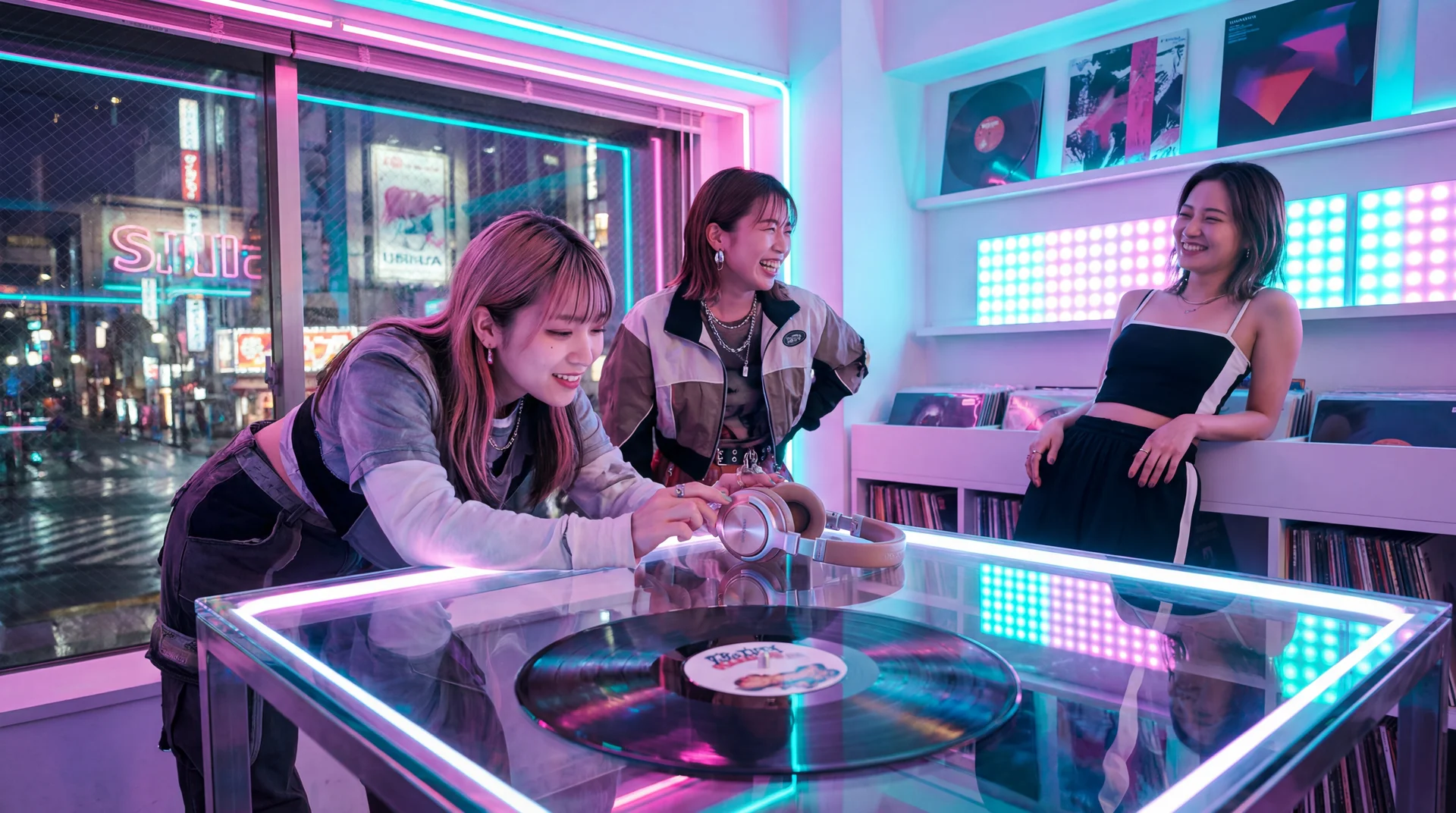
We are going to keep asking this question in record stores, on street corners, at festivals, and online. We are going to film the moment people hear a piece of music that moves them — and then tell them what made it. We are interested in the gap between the first reaction and the second thought. That gap is where the real conversation lives.
If you want to play, start at FakeAssRecords.com. If you want to argue, find us in the comments. If you want to change your mind about something, that might be the most interesting outcome of all.